What is meshing?
Meshing: The Silent Architect of Simulation Accuracy

In every major simulation—whether it’s modeling airflow around a jet, heat transfer in a turbine, or the load on a bridge—the mesh quietly determines how close you get to reality.
Yet it rarely gets the attention it deserves. Solvers, turbulence models, and post-processing visuals dominate conversations, while the very structure that supports them—the mesh—remains underestimated.
That’s beginning to change. As high-fidelity modeling, AI-assisted design, and cloud computation converge, meshing is becoming the new frontier of simulation accuracy and automation.
Meshing: More Than a Preprocessing Step
At its core, meshing is the act of discretizing a continuous geometry into smaller, solvable subdomains—elements in finite-element analysis (FEA) and cells in computational fluid dynamics (CFD). It’s what transforms theory into computation. This “discretization bridge” allows numerical methods to approximate the behavior of fluids, solids, and heat transfer. Without it, even the most sophisticated solver is blind.
Think of meshing as building the stage before the performance: if the stage is uneven, the performance falters. The goal is not simply to create a fine grid—it’s to create the right grid: dense where physics demand it, smooth where gradients are gentle, and efficient everywhere else.
“We don’t mesh for pretty pictures—we mesh to control error.”
Why Meshing Matters: The Engineering Multiplier
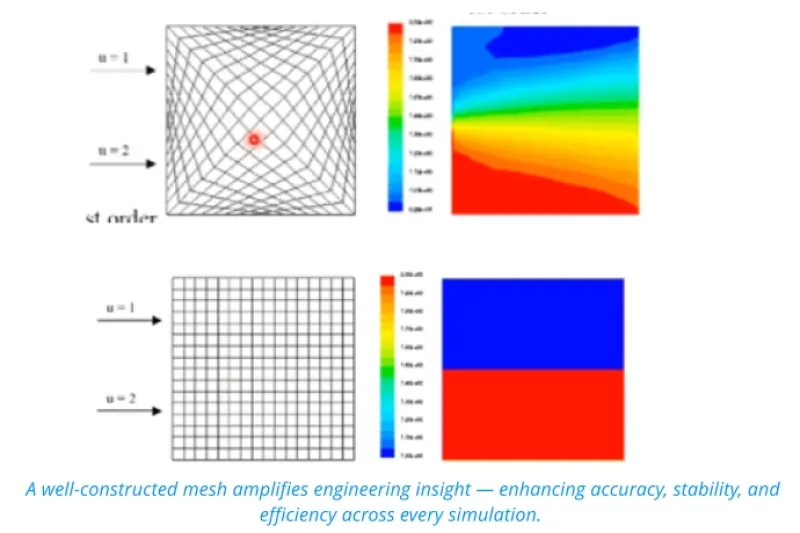
Meshing defines how the governing equations of physics interact with the geometry of your model. A great mesh doesn’t just enable a solution—it enables a stable, accurate, and trustworthy one. In CFD, it controls how turbulence, shocks, and flow separations are resolved. In FEA, it determines how stresses concentrate around fillets or holes.
Across both domains, the mesh directly influences:
- Accuracy – the fidelity of numerical approximation.
- Stability – the solver’s ability to converge without divergence.
- Efficiency – the balance between computational cost and precision.
That’s why experienced engineers treat meshing as a strategic step, not a procedural one. It’s where insight meets mathematics.
The Process Behind the Grid
Building a mesh is part geometry craftsmanship, part numerical reasoning.
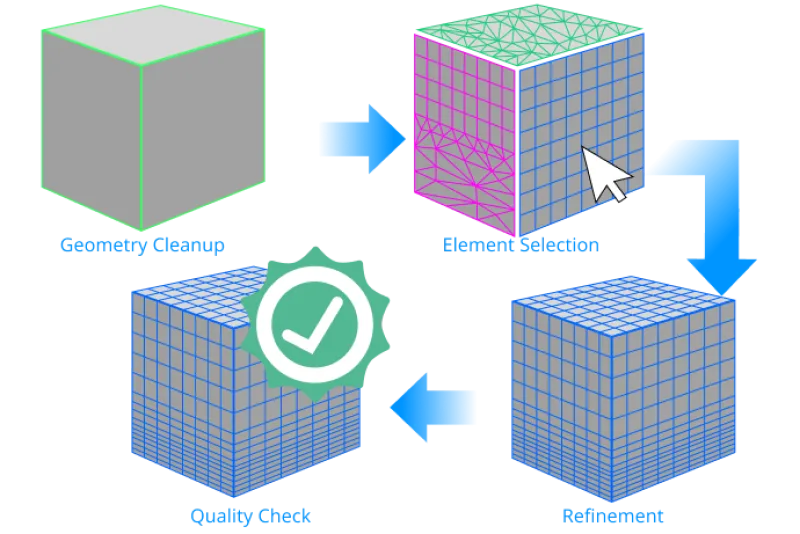
It typically unfolds in four stages:
- Geometry cleanup – simplify the CAD model, close gaps, remove irrelevant details, and define analysis boundaries.
- Element type selection – choose between tetrahedral, hexahedral, or polyhedral elements depending on geometry and physics.
- Refinement and sizing – decide where resolution must increase: near walls, boundaries, or stress risers.
- Quality inspection – evaluate metrics such as skewness, aspect ratio, and smoothness before solving.
Modern meshing tools automate parts of this workflow, but human judgment remains irreplaceable.
Automation accelerates, but intent validates.
The Many Faces of a Mesh
Different engineering goals require different mesh philosophies.
| Domain | Typical Elements | Strengths |
|---|---|---|
| CFD | Hexahedral, polyhedral | Excellent control over flow gradients |
| FEA | Tetrahedral, quadrilateral | Better for complex solid geometries |
| Multiphysics | Hybrid combinations | Flexibility across domains |
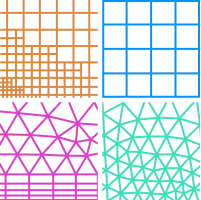
- Structured meshes (regular gridlines) offer predictability and computational speed.
- Unstructured meshes adapt easily to complex shapes.
- Hybrid meshes combine both: structure where possible, flexibility where needed.
Choosing the right mesh isn’t about software preference—it’s about physical intent.
Quality, Convergence, and Verification
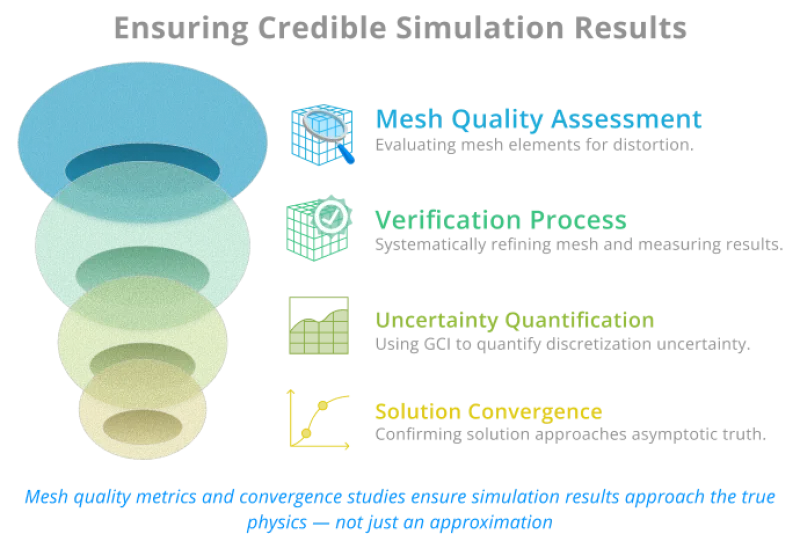
A solver’s credibility is only as strong as its grid. Mesh quality metrics—aspect ratio, skewness, orthogonality, and smoothness—quantify how well the elements capture local physics. Distorted elements can create numerical stiffness or inaccurate gradients.
Verification brings discipline to intuition. The Grid Convergence Index (GCI) remains the benchmark for quantifying discretization uncertainty. By refining the mesh systematically and measuring how results change, engineers can confirm whether their solution approaches the asymptotic truth.
“If you didn’t do a refinement study, you have a result—not an answer.”
That mindset, turns simulation into science.
The Challenges—and the Progress
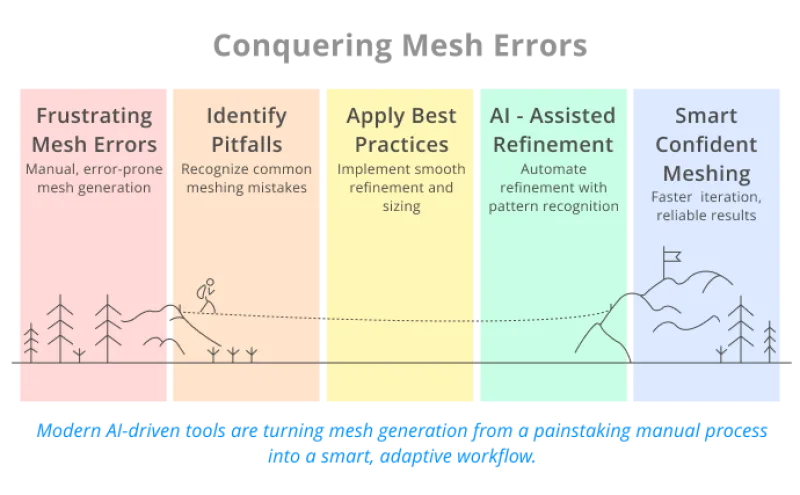
Every engineer who has spent a weekend fighting mesh errors knows the frustrations: sliver faces, non-manifold edges, impossible refinements. But modern workflows are steadily conquering them.
Common pitfalls:
- Over-refinement in unimportant zones
- Sharp gradients missed by coarse cells
- Poor transitions between element sizes
Best practices:
- Smooth refinement gradients (no abrupt jumps)
- Curvature-based sizing
- Verification after each adaptation step
Today’s meshing environments increasingly use AI-assisted pattern recognition, suggesting refinement zones automatically and learning from previous analyses. The result is faster iteration—and smarter confidence.
Adaptive and Intelligent Meshing
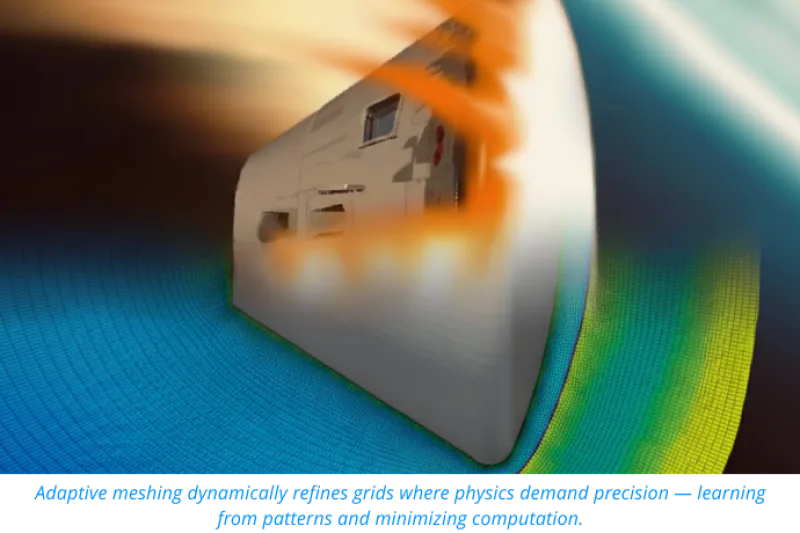
The evolution of meshing mirrors the evolution of simulation itself: from manual to automated, from static to adaptive, from reactive to predictive. Adaptive meshing adjusts resolution in real time based on error indicators or solution gradients. Some approaches rely on feature detection (shocks, vortices, stress peaks), others on goal-oriented refinement (regions influencing lift, pressure drop, or strain).
Recent advances have shown how these methods deliver higher accuracy per computational cost. And the next wave—AI-driven mesh generation—is already here, teaching software to infer optimal resolution before solving even begins.
Learning Curve and the Future of Meshing
Meshing used to be an art practiced by specialists. Today, tools are democratizing it—but understanding remains essential.
New engineers must learn:
- The relationship between geometry, physics, and discretization.
- How mesh topology influences solver stability.
- When to trust automation—and when to override it.
The future is hybrid: adaptive algorithms guided by human insight. Machine learning will handle repetition; engineers will handle reasoning.
“In the future, the best mesh might be the one you never have to build.”
The Bottom Line
Meshing is no longer a hidden step in the preprocessing chain—it’s the foundation of trustworthy simulation. It determines how we convert geometry into physics, intuition into numbers, and numbers into decisions.
As engineering moves toward digital twins and real-time simulation, those who understand the “why” behind the grid—not just the “how”—will define the next era of computational excellence.