Advantages of Structured MultiBlock Meshing

Structured MultiBlock Meshing: The Gold Standard for High-Fidelity CFD
Introduction
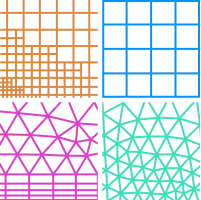
In the intricate world of Computational Fluid Dynamics (CFD), the mesh — the discretized foundation of your simulation domain — isn't just a byproduct; it's a critical determinant of your results' accuracy, stability, and efficiency. While various meshing philosophies exist, structured grids consistently stand out as a superior choice for achieving truly high-fidelity simulations.
When flow physics is subtle yet decisive—shock-induced boundary layer separation, vortices brushing narrow tip gaps, heat flux peaking on turbine vanes— the quality and structure of the mesh define how well reality is captured. Among the many gridding technologies available today, boundary-fitted structured multi-block meshes continue to set the benchmark for accuracy, efficiency, and solver robustness.
Every feature of their topology—regular connectivity, wall-aligned cells, smooth stretching—works in concert to extract more predictive power per cell than competing approaches. The following deep dive gathers the core advantages of structured grids, distilled from engineering experience across aerospace, turbomachinery, marine, energy, biomedical, and automotive simulations.
Capturing Boundary Layers with Precision
High-Reynolds-number flows develop extremely thin viscous layers on solid surfaces. Capturing them accurately demands finely stretched, wall-aligned cells with controlled growth rates.
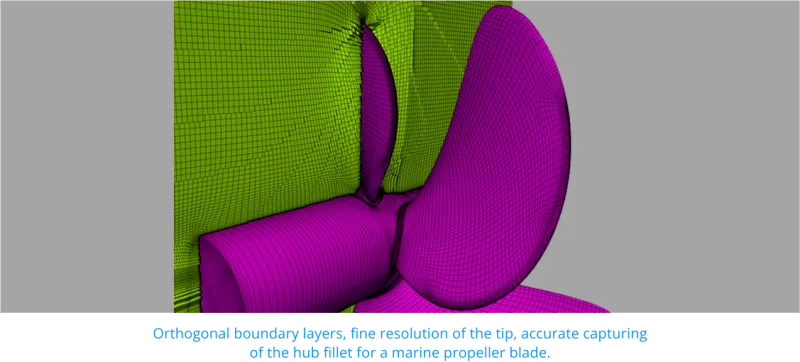
Structured meshes excel here. They place orthogonal, high-aspect-ratio cells exactly where gradients are steep, enforce first-cell heights that achieve Y⁺ < 1 while permitting gentle growth rates between successive layers. Such deliberate spacing preserves wall shear stress, wall pressure, and heat-transfer predictions—quantities that quickly degrade when cells are mis-aligned or excessively stretched.
Fewer Cells, Less Memory, Faster Runs
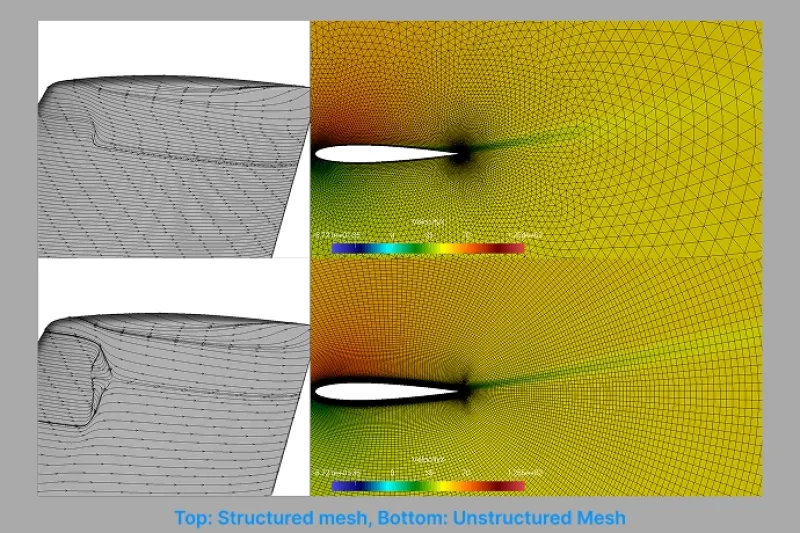
One of the strongest advantages of structured meshes is their element efficiency. Where an unstructured tetrahedral mesh may require millions of elements, a structured hexahedral mesh can achieve the same—or better—accuracy with far fewer cells.
A single hexahedral cell can replace multiple tetrahedra. This often results in a 2× to 10× reduction in cell count for the same accuracy level. Fewer cells mean lower memory usage and faster simulation times.
Memory footprints also shrink—regular connectivity lets solvers infer neighbours from indices instead of storing look-up tables, cutting storage needs by roughly three-to-one. CFD codes exploit this regularity to march quickly through stencils, yielding higher speed-ups.
Grid-Convergence Studies Made Simple
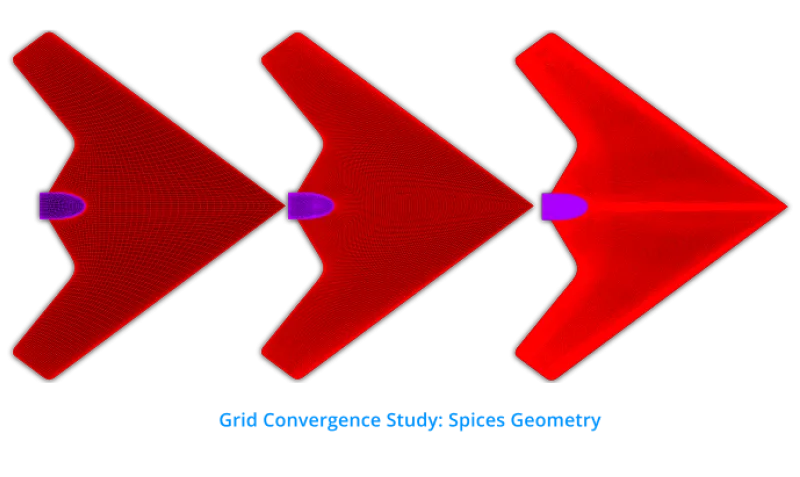
Validation demands more than one mesh. Structured systems ease the construction of a family of grids—coarse, medium, fine—each preserving identical block interfaces, stretching factors, and first-cell heights. Engineers can therefore refine by a fixed factor in every direction, watch residual uncertainties shrink systematically, and quantify numerical error with confidence.
Geometric Fidelity in Microscopic Gaps
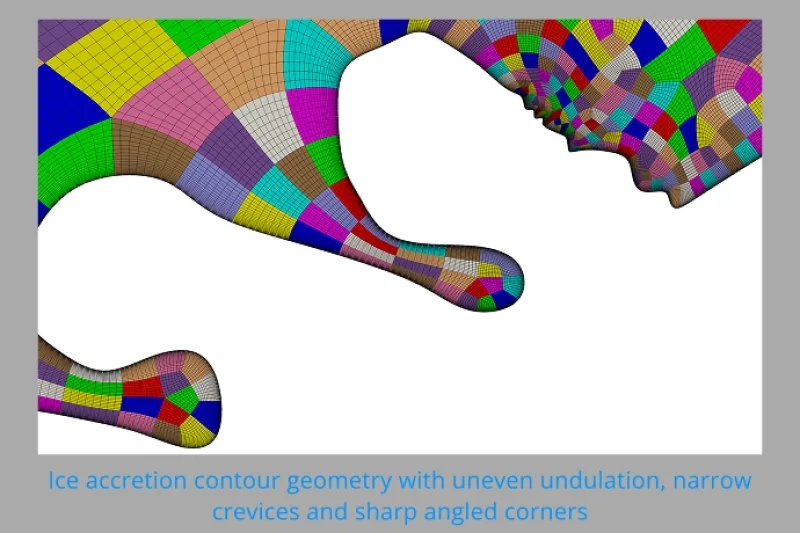
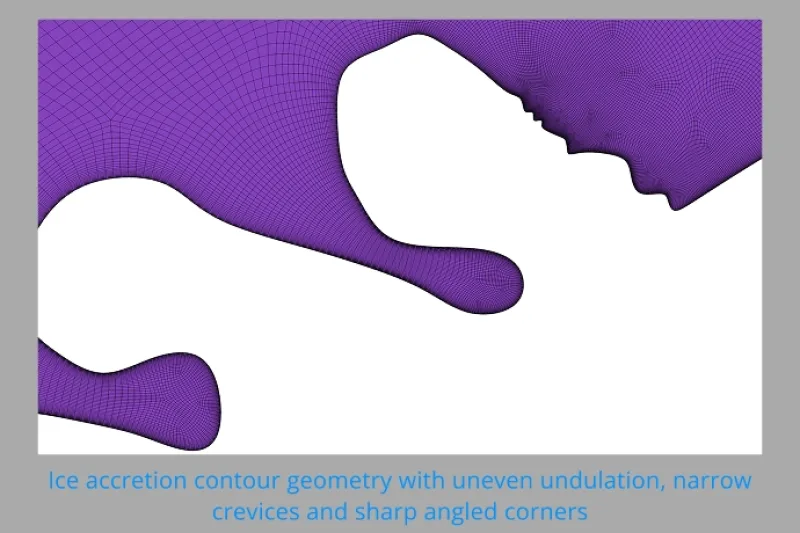
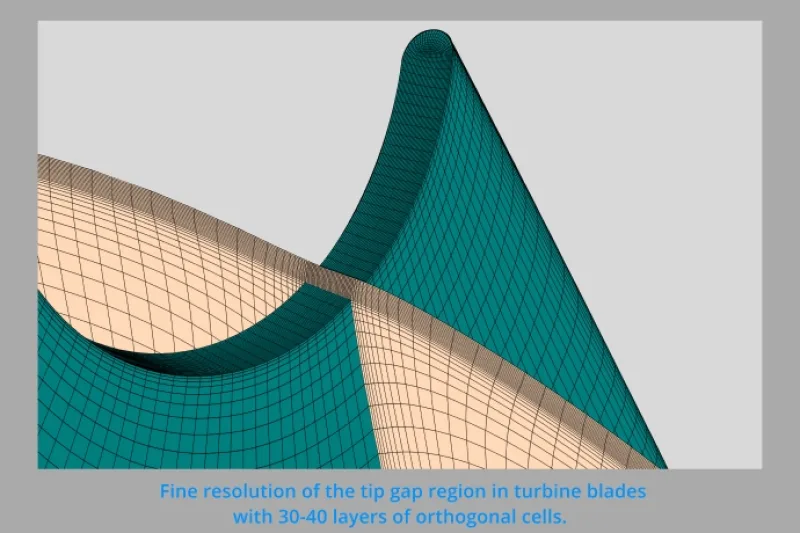
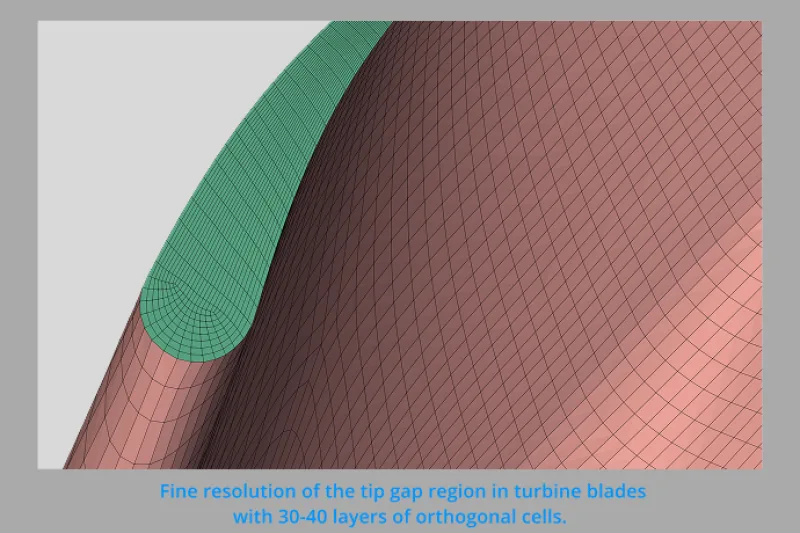
Many engineering applications involve very narrow gaps, sometimes as small as 0.05 mm. These clearances significantly impact overall performance, particularly in scroll compressors, propellers, and turbines.
Structured meshes can conform to these regions without sacrificing cell quality. Engineers often pack 40–50 layers through these gaps while preserving cell orthogonality.
Even in deforming or rotating geometries, structured blocks maintain their integrity. This eliminates mesh folding and avoids solver instability during transient runs.
Consistency Across Design Variants
In optimisation campaigns, each geometric variant should differ only in the physics it introduces—not in unintended mesh artefacts. When simulating multiple design variants, mesh quality and structure should not vary. Otherwise, performance differences may be due to mesh artifacts rather than actual design changes.
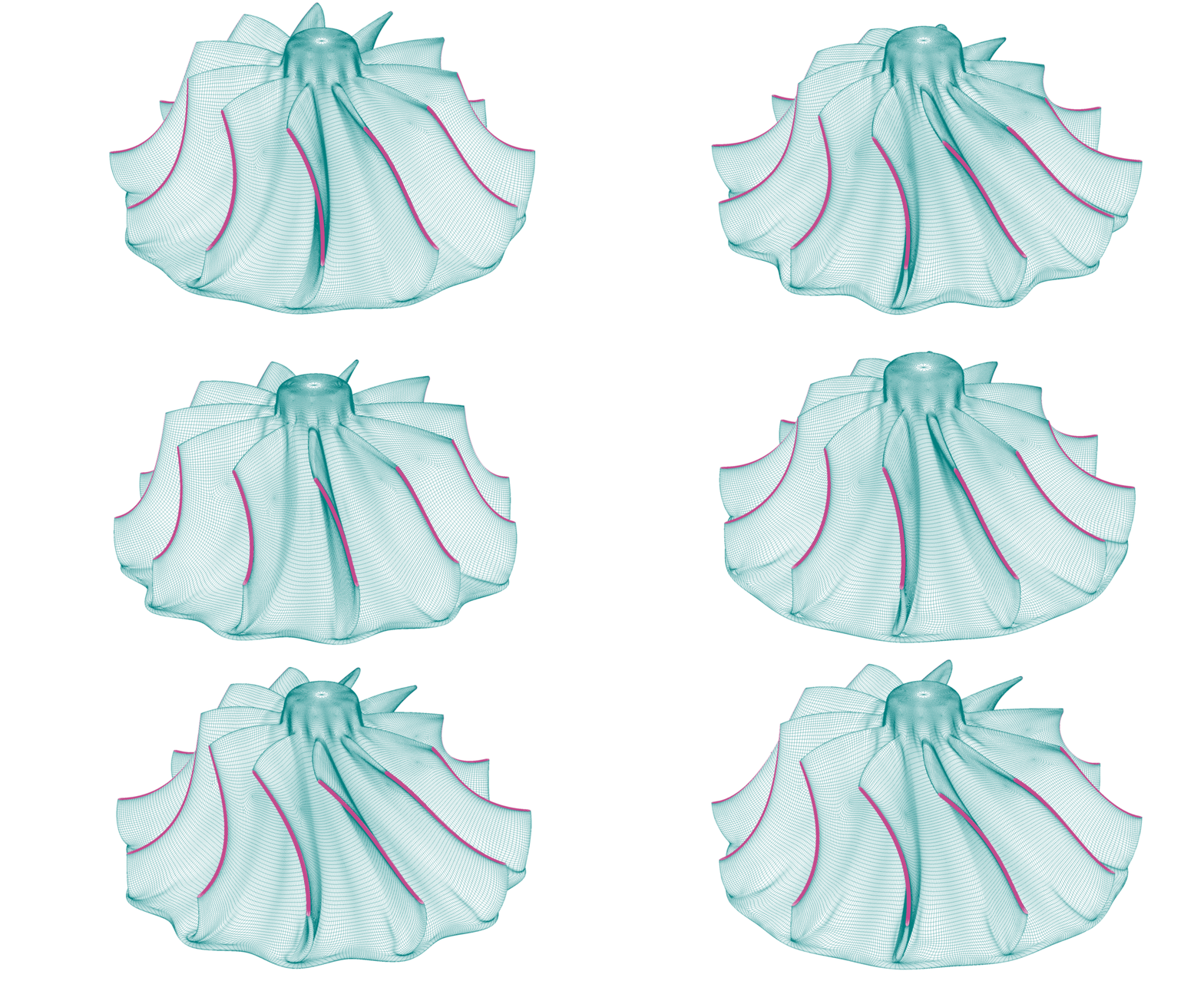
Structured multi-block meshes allow for reusable topological templates. These templates let engineers duplicate element alignment, distribution, and quality across a family of designs.
This consistency improves the reliability of performance trends. Engineers can confidently compare different geometries knowing that the mesh is not introducing bias.
Flow Alignment Cuts Numerical Dissipation
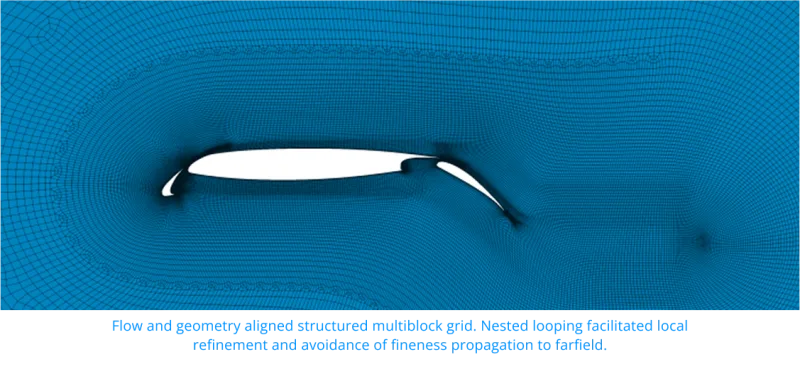
Structured meshes can be generated to follow flow features—boundary layers, shear layers, wakes, and shocks. When cells align with the flow, numerical errors such as dissipation and artificial thickening are greatly reduced.
Flow-aligned meshes help preserve sharp gradients and vortical structures. Features like shock waves or tip vortices remain well-resolved rather than smearing across cells.
In contrast, isotropic unstructured meshes can misrepresent such flow phenomena. Their random orientation introduces cross-flow errors that affect accuracy.
Solver Robustness and Faster Convergence
Structured grids are inherently more stable for solvers. Their regular connectivity and smooth variation in cell sizes prevent the convergence issues often caused by skewed or distorted elements. Poorly aligned, highly skewed elements can sabotage non-linear stability and stall convergence.
Structured meshes avoid these traps through controlled aspect ratios, smooth cell-size transitions, and orthogonality near walls. Solvers using structured meshes can reach residual targets more quickly. The reduced cell count and regular data access patterns also enhance numerical efficiency.
This reliability becomes especially important in simulations involving moving meshes. Structured grids retain quality over time, avoiding the pitfalls of negative volumes or crashing solvers.
Consistency Across Different CFD Codes
Large community workshops, such as AIAA’s Drag Prediction and High-Lift Prediction series, repeatedly show that structured submissions exhibit less scatter between solvers. Because the grid itself introduces minimal numerical error, variations in turbulence modelling or discretisation order become easier to diagnose. When an analyst can trust that the mesh is not the hidden culprit, cross-code benchmarking gains credibility.
In large-scale validation projects, consistency across codes is key. Structured meshes reduce the impact of meshing differences, allowing engineers to focus on solver behavior and physical models.
As a result, conclusions drawn from such comparisons are more credible. Structured meshing acts as a neutral platform for cross-code collaboration.
Resolving Complex Three-Dimensional Details
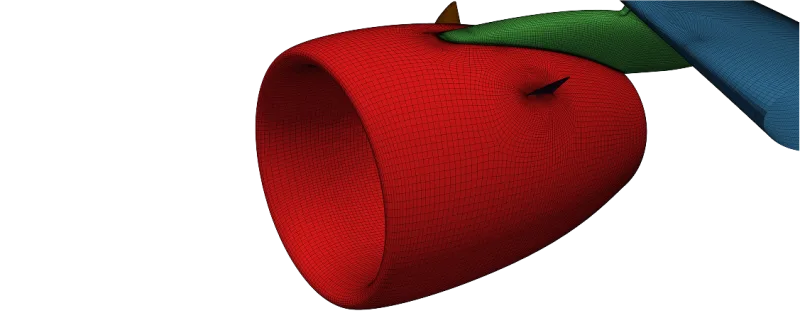
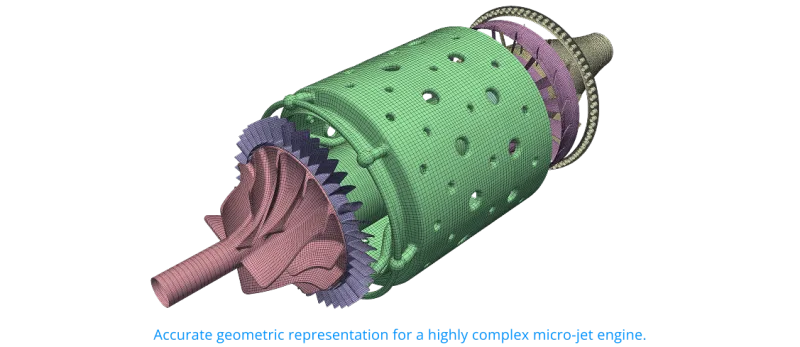
Engineering geometries are rarely simple. Structured multi-block meshing allows engineers to wrap cells around complex features while preserving high resolution and element quality.
Cavitating propellers or stator/rotor tip gaps require intricate surface tracking. Structured hexahedral blocks, laid out to hug geometry, capture subtle curvature and radial variations. For a turbine blade with both a tip gap and thick boundary layer, engineers have successfully deployed 150 – 160 radial layers and 7 – 9 million structured cells—numbers practical only because the underlying topology remains efficient.
Unlike unstructured meshes, which often lose detail or create skewed elements in tight regions, structured blocks conform tightly to surfaces. The result is a smooth, accurate geometric representation throughout the domain.
A Tool That Bridges Geometry, Physics, and Accuracy
Structured meshing brings together geometric fidelity and physics-aware resolution. It aligns cells with the flow, resolves tight gaps, and offers predictable grid convergence behavior.
It also offers tangible gains in simulation speed and memory usage. Whether for steady-state aerodynamics or unsteady thermal loading, it consistently delivers results engineers can trust.
As simulation workflows grow more complex, structured meshes retain their relevance. They offer clarity, control, and confidence—qualities that are increasingly rare in automated meshing pipelines.
Putting It All Together
- Boundary-layer resolution delivers credible heat-transfer, skin-friction, and shear predictions.
- Element efficiency slashes cell counts and memory, accelerating design cycles.
- Grid-convergence families expose numerical uncertainty in a controlled, repeatable way.
- Quality in tight clearances supports applications from compressors to biomedical devices.
- Uniform templates ensure fair comparison across parameter sweeps.
- Flow-aligned blocks curb dissipation and sharpen shocks and vortices.
- Robust convergence shortens wall-clock time and guards against solver crashes.
- Cross-code consistency elevates collaborative benchmarking.
- Geometric fidelity in three-dimensional detail preserves the physics engineers care about most.
Conclusion
Structured multi-block meshing is sometimes portrayed as old-school in an era dominated by unstructured generators. Yet its virtues remain uniquely compelling wherever predictive accuracy, computational economy, and solver reliability intersect. From sub-millimetre gaps in scroll compressors to the supersonic wakes of launch vehicles, structured grids align with both the geometry and the physics, ensuring that numerical bandwidth is spent on resolving the flow—not compensating for mesh artefacts.
For researchers pushing the boundaries of engineering design and scientific discovery, investing in the rigor of structured meshing pays dividends in confidence and insight. For engineers tasked with extracting every last insight from CFD, a disciplined structured-grid workflow is not an anachronism but a strategic advantage.