Flow Physics Capturing
Flow physics capturing is a crucial aspect of computational fluid dynamics, enabling the accurate representation of major flow phenomena such as wakes and shocks. To achieve this, smart topology building techniques come into play, tailoring grid blocks to effectively capture these phenomena with optimal grid density.
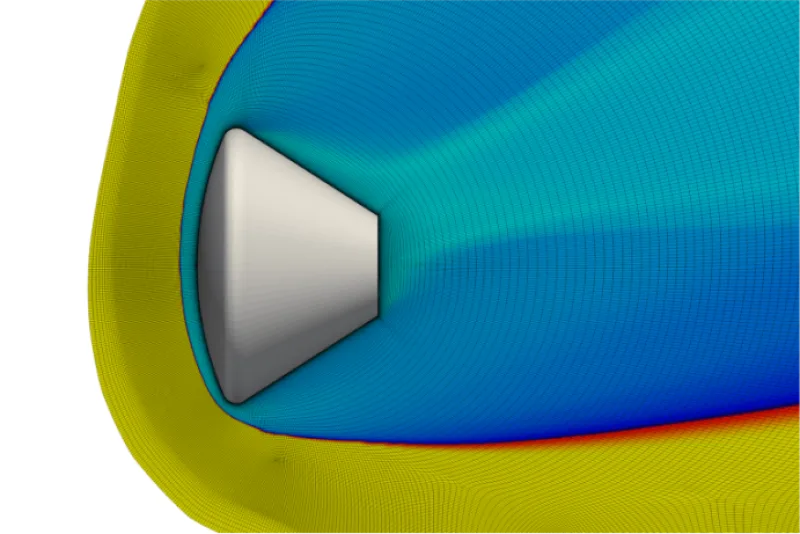
Shock capturing
In high Mach number flows featuring bow or oblique shocks, a precise shock capturing method is essential. The approach involves strategically laying out grid blocks around the known shock position. These blocks are positioned right at the discontinuity, forming a dense cloud of grid points that effectively capture the shock. Gradually, as we move away from the shock location, the grid smoothens out. Importantly, the density in the central cocoon of blocks can be varied according to the user's desired level of resolution, without affecting the neighboring block grid size. This innovative strategy allows for optimal shock representation while maintaining computational efficiency.
Wake capturing
The long wakes behind aerospace vehicles can be accurately captured, by using a looping topology. This approach employs stretched high aspect ratio cells, carefully chosen to effectively capture the wake while maintaining an optimal cell count. By widening the loop, a larger region encompassing the upper part of the airfoil/wing and the downstream area can be accounted for, resulting in improved wake capturing and flow separation, even at high angles of attack.
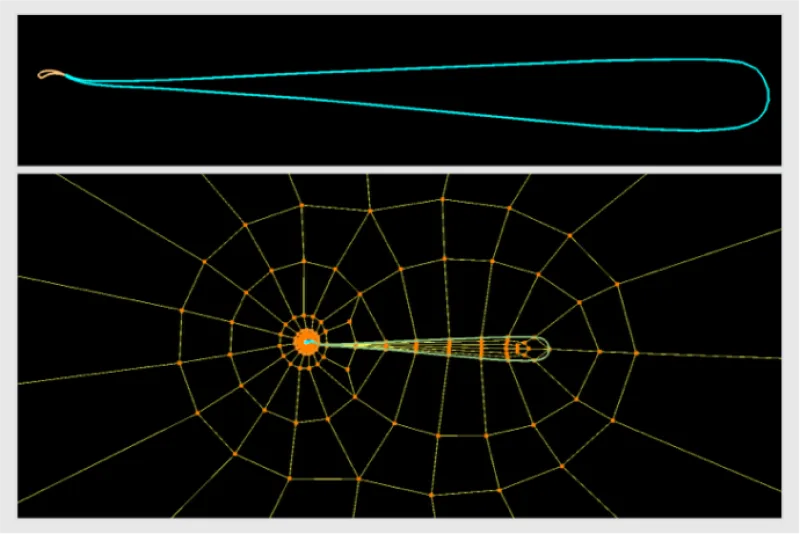
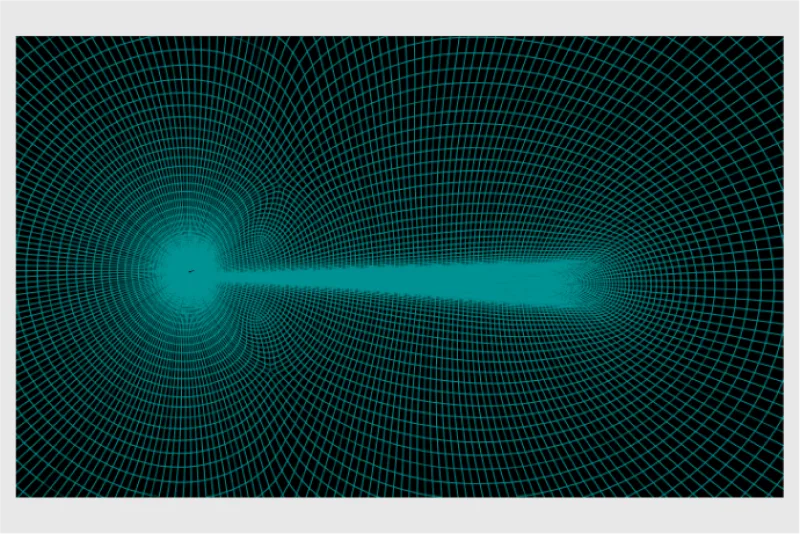
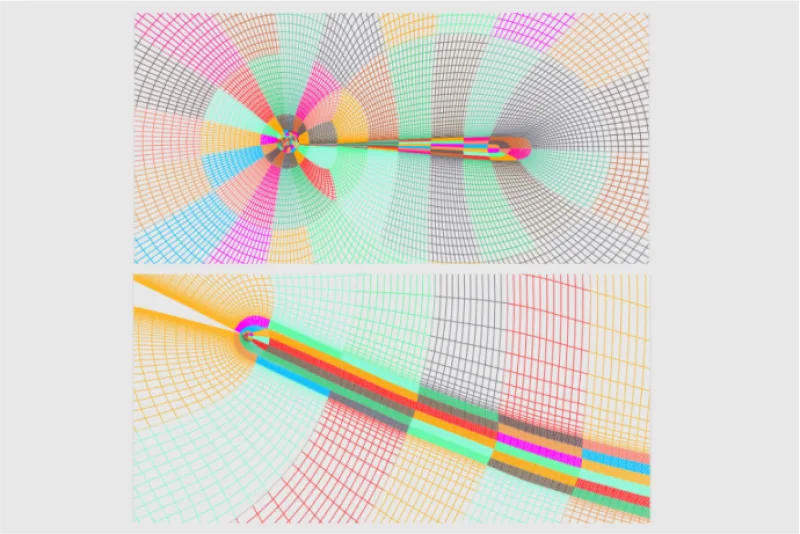
The key advantage of this blocking strategy lies in its ability to prevent the unnecessary propagation of mesh fineness further downstream, thus facilitating the generation of an optimal grid. Unlike the C-type grid, the boundary layer's fineness does not propagate downstream, and users have control over the aspect ratio of the cells within the loop. Moreover, this approach offers flexibility to cater to varying user requirements, reducing the likelihood of CFD solvers facing errors or blowing-up.
Read more about Flow Physics Capturing from our articles:
Fast and Accurate Hypersonic CFD Simulations: Impact of Automatic Shock-Aligned Meshes