Transforming Human Eye Simulations with GridPro’s CFD Meshing Software
Introduction: Advancing Ocular CFD with Robust Mesh Generation
Understanding aqueous humor flow in the human eye is crucial for ophthalmology and biomedical research. GridPro’s CFD meshing software empowers researchers with high-fidelity simulations, revealing deeper insights into intraocular pressure, fluid dynamics, and surgical outcomes for glaucoma and other ocular conditions.
By providing precise mesh control, GridPro enables accurate visualization of complex flow patterns within the eye, driving advancements in diagnosis and treatment planning.
Challenges in CFD Mesh Generation for Ocular Fluid Dynamics
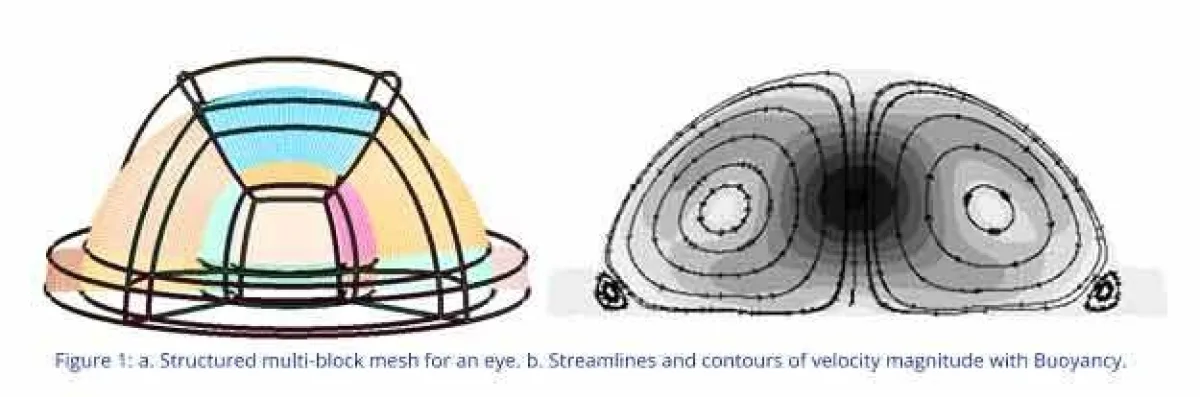
The anterior chamber of the human eye presents a particularly challenging geometry for CFD mesh generation. Its compact, curved structure and microscale features—especially around the trabecular meshwork (TM)—require exceptional mesh quality and boundary resolution.
Conventional meshing methods often simplify these intricate regions, leading to inaccuracies in three-dimensional flow modeling and pressure distribution. Such limitations hinder the predictive accuracy of simulations, particularly for understanding fluid behavior near the TM, where even minute variations can influence intraocular pressure.
Accurate mesh generation is therefore essential for predicting outcomes in conditions like angle-closure glaucoma and for simulating surgical interventions such as iridectomy or trabeculectomy.
Results: Clinical Impact Powered by GridPro’s CFD Meshing Software
Using GridPro’s advanced meshing capabilities, researchers have achieved significant improvements in ocular CFD simulations. Buoyancy-driven flow within the aqueous humor is now modeled with high fidelity, revealing sustained circulation patterns essential for nutrient transport influenced by subtle temperature gradients.
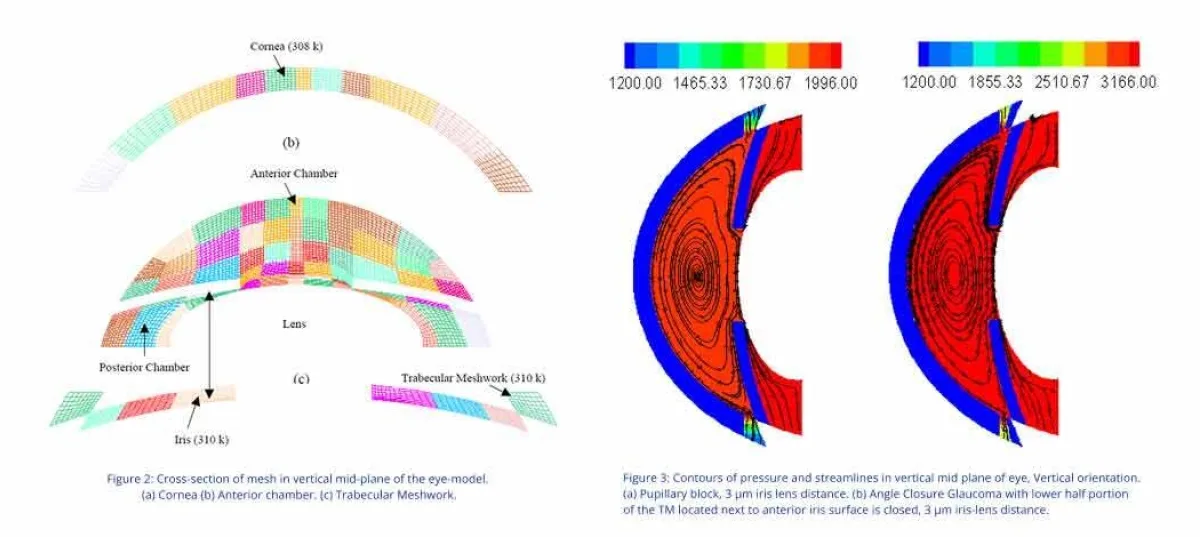
The ability to track micro-level pressure changes has transformed glaucoma modeling, helping researchers observe the effects of trabecular pore constriction on intraocular pressure. GridPro’s meshes also play a vital role in simulating surgical outcomes.
Virtual iridectomy and other ocular procedures can be tested in silico, showcasing how mesh design impacts fluid relief pathways and pressure distribution, ultimately guiding more effective clinical strategies.
Why Choose GridPro as Your CFD Meshing Software?
GridPro’s strength lies in its optimization for highly complex geometries and biomedical environments. Its flexible meshing templates allow researchers to easily prepare geometric variants for parametric and comparative studies, saving both time and computational resources.
The software ensures superior simulation accuracy by minimizing numerical diffusion and improving convergence, which is critical for producing clinically relevant results. Furthermore, GridPro is designed to handle ultra-high cell counts efficiently, enabling large-scale biomedical CFD studies without excessive computational overhead. The validated results produced using GridPro have consistently demonstrated its reliability in supporting groundbreaking research across biomedical engineering disciplines.
Conclusion: GridPro Sets the Benchmark for CFD Meshing Software in Biomedical CFD
GridPro’s cutting-edge CFD meshing technology has redefined what is possible in ocular fluid dynamics research. By delivering robust, anatomically accurate, and computationally efficient mesh generation, it empowers researchers and clinicians to explore new frontiers in healthcare engineering and medical device design.
As biomedical CFD continues to evolve, GridPro remains a trusted partner in enabling deeper understanding, better predictions, and more effective clinical outcomes.