High-Fidelity Structured Meshing for Predicting Submarine Manoeuvring Forces
High-Fidelity Structured Meshing for Predicting Submarine Manoeuvring Forces
Accurately predicting manoeuvring forces on submarines requires more than just a powerful CFD solver—it demands a mesh that preserves geometry, minimises numerical error, and stabilises complex vortex-dominated flows. This case study shows how GridPro’s multiblock structured meshing played a critical role in enabling high-accuracy submarine CFD simulations for DARPA SUBOFF geometries.
INTRODUCTION
Understanding how submarines behave under different manoeuvring conditions is essential for design, control, and safety. Traditional experimental testing is often expensive, time-consuming, and limited by support-structure effects. CFD offers an efficient alternative—but only when supported by a robust and accurate mesh.
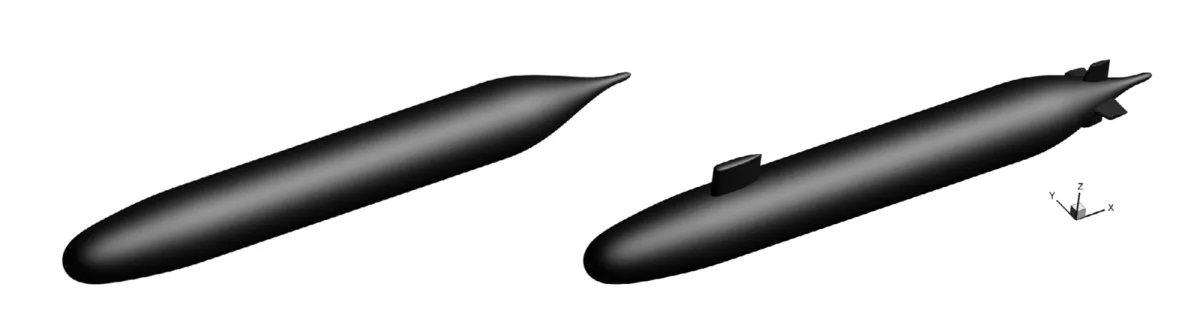
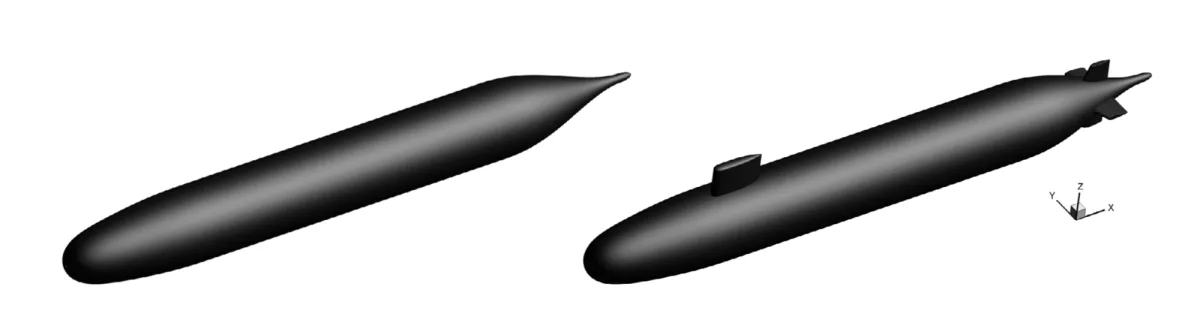
In the research by MARIN and collaborators, manoeuvring forces for bare-hull (AFF-1) and appended (AFF-8) DARPA SUBOFF configurations were predicted using viscous-flow solvers. GridPro’s structured multiblock grids were used for the most complex geometry—the appended hull—resulting in smooth, orthogonal meshes that helped achieve superior convergence, reduced numerical errors, and highly reliable validation against experiments.
This case study summarises how GridPro contributed to delivering high-fidelity CFD insights for submarine hydrodynamics.
CHALLENGES
- Capturing Complex Appendage-Driven Flow Physics: The appended configuration (AFF-8) includes a sail and multiple stern control surfaces, producing vortices, separation zones, and intricate wake interactions. These features demand exceptional mesh quality to maintain numerical stability and accuracy. The use of structured grids is particularly challenging when geometry involves sharp junctions and curved surfaces.
- Ensuring Accurate Boundary-Layer Resolution: Submarine prediction accuracy is highly dependent on wall-resolved mesh quality (y+ < 1). Generating such fine boundary-layer meshes consistently across appendages and junctions is difficult using unstructured meshing workflows. Grid skewness or abrupt cell transitions can amplify modelling errors.
- Minimising Iterative and Discretisation Errors: For high-Reynolds-number submarine flows, iterative residuals, grid smoothness, and orthogonality directly affect solver convergence. In many mesh generators, complex appendage topologies often produce inconsistencies that degrade solver performance.
- Maintaining Accuracy During Oblique Inflow and Dynamic Motion: At large inflow angles and during forced-pitching manoeuvres, the flow becomes highly unsteady with strong shear layers and vortex shedding. Such conditions require mesh uniformity and high-quality clustering to avoid artificial dissipation or numerical instability.
SOLUTIONS
GridPro addressed these challenges through its robust multiblock structured meshing framework.
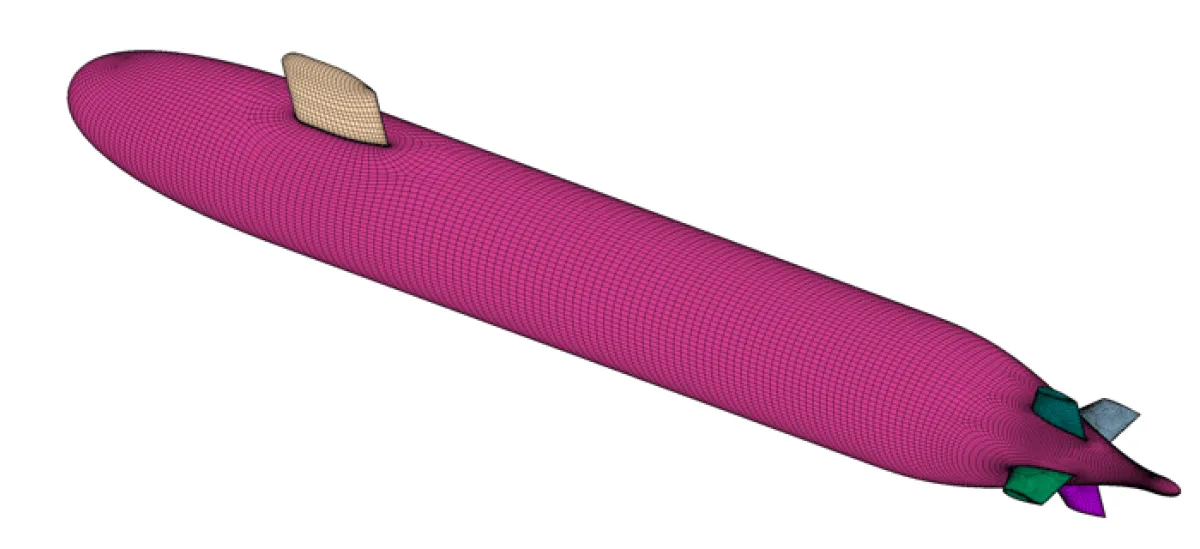
- Fully Structured O-O Topology for Maximum Smoothness: A fully structured multiblock topology for AFF-8 was generated, ensuring highly smooth cell transitions and excellent orthogonality even around difficult junctions such as the sail–hull and fin–hull interfaces. This drastically reduced solver instability and improved accuracy in predicting both forces and wake characteristics.
- Boundary-Layer Conforming High-Resolution Grids: Using the curvature-aware spacing in the meshing software and robust boundary-layer control, the meshes achieved y+ << 1 without wall functions. This enabled solvers to resolve viscous effects accurately—critical for drag, lift and moment predictions.
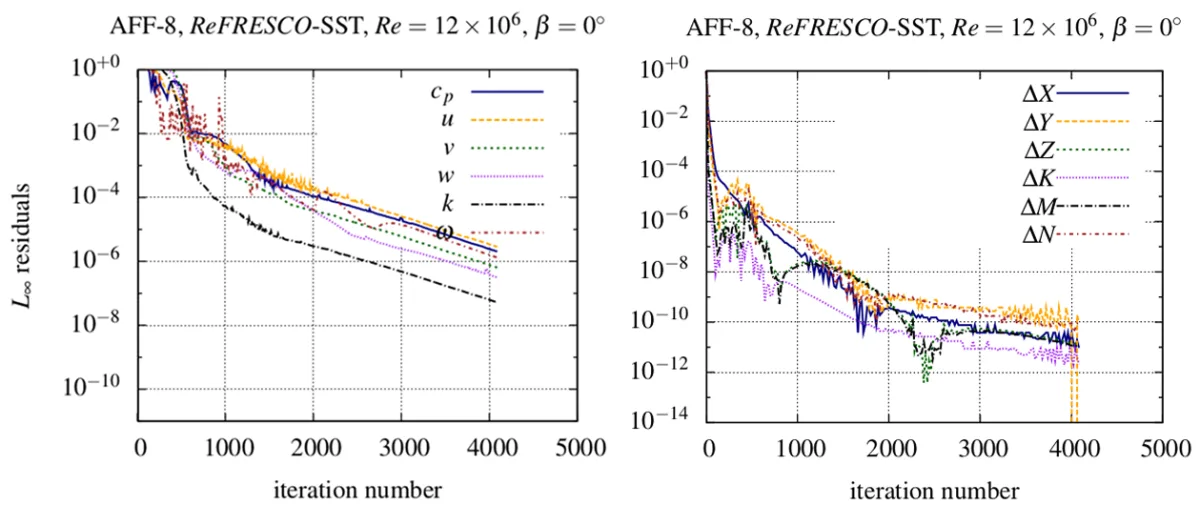
- Superior Convergence Enabled by Mesh Quality: With the structured grids, the AFF-8 simulations achieved convergence to residual levels below 3×10⁻⁶ within only 4000 iterations, significantly faster than comparable in-house meshes. The solver required fewer relaxation adjustments, indicating exceptional numerical stability.
- Consistent Accuracy for Oblique Flow and Complex Wake Fields: The structured mesh topology preserved flow features essential for manoeuvring predictions, including, horseshoe vortices at appendage junctions, sail-induced tip vortices, asymmetric wake fields at 18° drift angles and propeller-plane wake profiles. These features are notoriously hard to capture using unstructured meshing but were cleanly resolved using the structured approach.
- Ready Integration With High-Fidelity RANS and DDES Solvers: The hexahedral structured grids were directly used with MARIN’s ReFRESCO solver for RANS computations and compared against commercial DDES results. The structured mesh contributed to better stability in steady simulations and accurate reproduction of flow physics.
RESULTS
Using GridPro-generated meshes, the CFD predictions for the AFF-8 SUBOFF achieved strong agreement with experimental pressure distributions, wake profiles and force data. The predicted drag showed less than one percent variation across mesh refinements, demonstrating good spatial-discretisation behaviour.
The wake field at the propeller plane was captured with minimal sensitivity to grid refinement, indicating that the structured mesh allowed the solver to reproduce the physical wake deficit with reliability. When compared with experimental wind-tunnel wake data, the CFD results aligned closely despite the experimental setup lacking the sail.
For the oblique-flow case at eighteen degrees drift, the structured mesh preserved essential flow features, including the large separation region on the leeward side of the sail, the tip vortex emerging from the sail, the downward-deflected flow behind the appendages and the asymmetric vortex street on the starboard side of the hull. These complex patterns were carried into the propeller disk with clarity, illustrating the ability of the mesh to support high-fidelity flow-field resolution.
In dynamic simulations involving a forced pitching manoeuvre, the uniform topology of structured multi block mesh enabled the solver to capture both static and dynamic moment behaviour, including added-mass effects that created phase differences between pitch angle and hydrodynamic response. The accuracy of these simulations depended heavily on mesh smoothness, and the structured block topology ensured stable temporal evolution throughout the manoeuvre.
CONCLUSION
The study demonstrates that structured multiblock meshing significantly enhances the accuracy and stability of CFD simulations for submarine manoeuvring. By providing smooth, orthogonal, boundary-layer-conforming grids for the AFF-8 configuration, flow aligned hexahedral meshes enabled the solvers to predict forces, pressure distributions and wake structures that aligned closely with experimental data. Its contribution was particularly important in scenarios involving strong vortical interactions, appendage-dominated flows and dynamic motions, where mesh continuity directly influences solver performance.
When paired with RANS or DDES solvers, GridPro enables reliable, experimentally validated CFD insights—making it a preferred choice for naval hydrodynamics, underwater vehicle design, and manoeuvring performance analysis.