High-Fidelity Structured Mesh Generation for NASA’s Supersonic Inflatable Aerodynamic Decelerator (SIAD)
When NASA set out to simulate its Supersonic Inflatable Aerodynamic Decelerator, accuracy was non-negotiable. GridPro’s structured multiblock meshing delivered the precision needed to capture complex flow physics, dynamic motion, and wake interactions—empowering NASA’s team to achieve CFD results that aligned flawlessly with experimental observations.
INTRODUCTION
The Supersonic Inflatable Aerodynamic Decelerator (SIAD), developed under NASA’s Low Density Supersonic Decelerator (LDSD) project, represents a breakthrough in atmospheric entry technology. Designed to slow spacecraft traveling at supersonic speeds in thin planetary atmospheres, the SIAD was tested in the Hypervelocity Free-Flight Aerodynamics Facility (HFFAF) at NASA Ames.
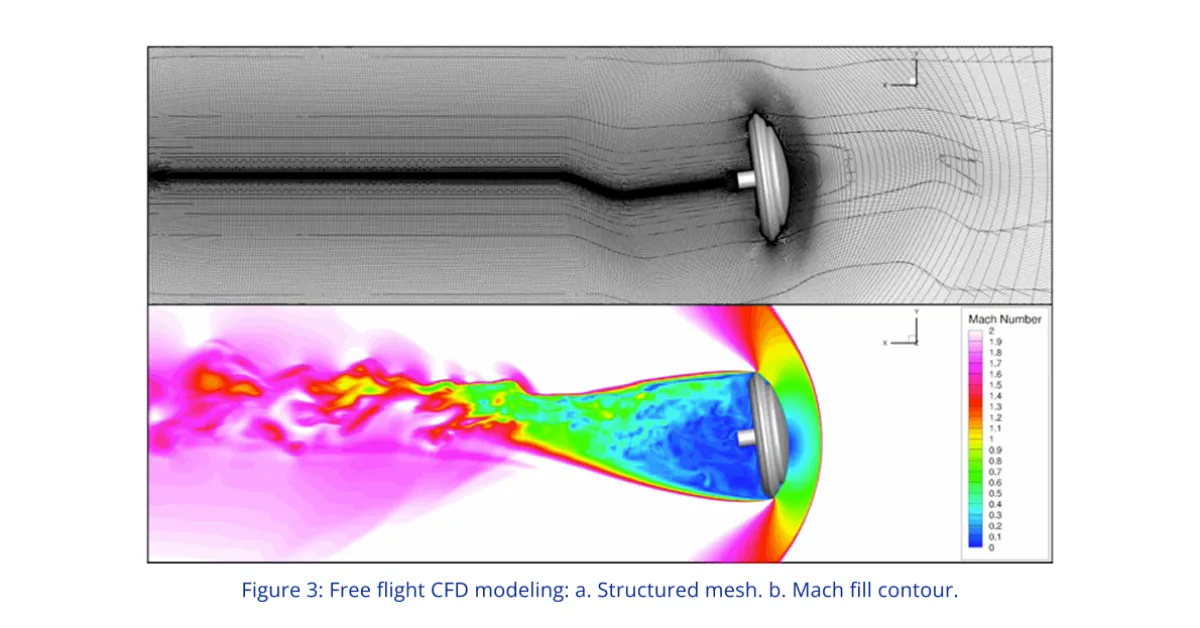
To accurately predict the aerodynamic behavior of the SIAD during these ballistic range tests, NASA and AMA Inc. performed advanced Computational Fluid Dynamics (CFD) simulations using the US3D solver. Generating a reliable and high-resolution computational mesh for such a complex, deforming geometry required an advanced grid generation tool. For this purpose, the research team used GridPro software, a structured multiblock mesh generator known for its precision, robustness, and adaptability to complex aerospace geometries.

CHALLENGES
Meshing and simulating the supersonic decelerator introduced several critical challenges:
- Complex Inflatable Geometry: The SIAD combined a rigid forebody with an inflatable toroidal skirt. The grid needed to conform seamlessly across these geometrically distinct regions.
- Dynamic Motion and Mesh Deformation: The simulation required modeling free-flight motion involving pitch, yaw, and roll, demanding smooth mesh deformation without loss of orthogonality.
- Capturing Unsteady Wake Dynamics: Accurate representation of shock–shear interactions and vortex structures in the wake called for localized mesh refinement while maintaining structured connectivity.
- Wall-Resolved LES Requirements: To support Large Eddy Simulation (LES) and Detached Eddy Simulation (DES) turbulence models, the mesh required extremely fine near-wall spacing (≈0.1 µm) achieving y⁺ < 1.
- Computational Performance: The grid needed to scale efficiently on high-performance clusters for time-accurate CFD simulations using 22 million hexahedral cells.
SOLUTIONS
Using topology-based multiblock grid generation, the NASA–AMA team built a highly detailed and flexible mesh that met the stringent simulation requirements for supersonic flow around the SIAD.
- Topology-Driven Structured Meshing: GridPro’s block topology approach ensured smooth transitions between the forebody and inflatable skirt, maintaining consistent orthogonality and low skewness.
- Localized Adaptive Refinement: Nested refinement zones provided high resolution in critical wake regions, with the smallest cell size around 0.4 mm, enabling accurate prediction of flow separation and unsteady vortex shedding.
- Dynamic Mesh Capability: The structured mesh supported rigid-body deformation, allowing the US3D solver to simulate realistic vehicle rotations while preserving grid quality.
- Accurate Boundary-Layer Capture: Fine first-layer spacing ensured that wall shear stress and thermal gradients were well resolved, critical for predicting aerodynamic stability in supersonic regimes.
- Parallel Computation Efficiency: The well-organized block structure allowed balanced domain decomposition, enabling efficient parallel execution. The initialization phase took approximately five hours, while the complete dynamic trajectory simulation was completed in roughly 200 hours (8 days) using 256 cores.
RESULTS
The high-quality structured mesh enabled the US3D solver to produce outstanding agreement with experimental data from ballistic range tests.
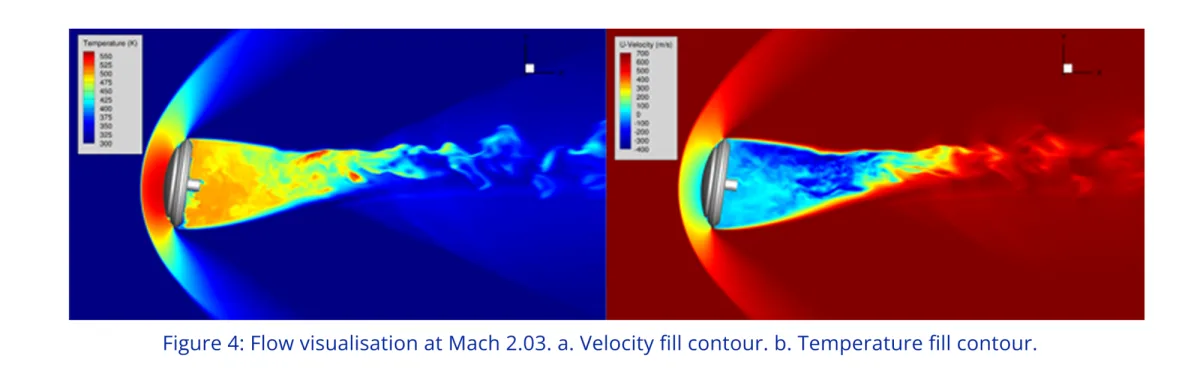
- Flow Field Accuracy: Density gradient contours from CFD closely matched experimental shadowgraph images, validating the mesh resolution and numerical fidelity.
- Dynamic Response Prediction: The simulated pitch, yaw, and total angle of attack showed near-perfect correlation with measured data, confirming accurate aerodynamic modeling.
- Aerodynamic Coefficient Agreement: Using NASA’s CADRA2 tool, derived coefficients for drag, lift, and pitching moment showed excellent alignment with experimental trends.
- Wake Physics Insight: Pressure probes in the wake revealed time-delayed pressure responses consistent with known instability mechanisms, providing valuable insight into the fluid–structure coupling behind supersonic decelerators.
CONCLUSION
This study showcases how multiblock structured mesh generation was instrumental in the successful CFD simulation of NASA’s Supersonic Inflatable Aerodynamic Decelerator (SIAD). By enabling precise geometry representation, robust dynamic mesh motion, and optimized flow resolution, GridPro mesh generator provided the foundation for accurate prediction of vehicle dynamics and wake behavior at supersonic speeds.
The results demonstrated that a high-quality hexahedral mesh is essential for reliable supersonic CFD simulations. The meshing software’s capability to handle complex topologies and maintain grid integrity under motion made it the preferred tool for NASA’s dynamic stability studies.