Adaptive Structured Meshing for Hypersonic Reentry Capsule CFD
Accurate hypersonic reentry capsule CFD requires precise resolution of shocks, boundary layers, and wake structures. This case study demonstrates how GridPro’s adaptive structured meshing philosophy, aligned with advanced adaptive mesh refinement research, enables high-fidelity reentry simulations with significantly reduced computational cost.
INTRODUCTION
Hypersonic reentry capsule CFD represents one of the most demanding applications of computational fluid dynamics. As a capsule reenters the atmosphere, it encounters extreme Mach numbers, generating strong detached bow shocks, shock–shock interactions, steep thermal gradients, and complex unsteady wake structures. Predicting aerodynamic forces, surface pressure, and heat flux under these conditions requires both numerical accuracy and robust meshing strategies.
Traditionally, achieving this accuracy has relied on globally refined meshes, often resulting in millions of cells and long turnaround times. Recent research on adaptive mesh refinement (AMR) for capsule aerodynamics demonstrates that solution accuracy depends far more on where resolution is placed than on overall mesh density. From GridPro’s perspective, this insight strongly reinforces the value of structured multiblock meshing, where topology, alignment, and controlled refinement are central to solution quality.
By combining GridPro’s structured mesh generation capabilities with adaptive refinement strategies validated in hypersonic CFD research, reentry capsule simulations can achieve grid-converged results with far fewer cells. This case study highlights how adaptive structured meshing improves accuracy, efficiency, and scalability for reentry capsule CFD.
CHALLENGES
Reentry capsule aerodynamics impose multiple, competing requirements on the computational mesh. Near the capsule surface, very fine resolution is essential to capture viscous boundary layers and accurately predict surface pressure and heat transfer. Ahead of the capsule, a detached bow shock forms, requiring sharp spatial resolution to avoid shock smearing and excessive numerical dissipation. Downstream, the wake region contains shear layers and unsteady flow structures that influence integrated aerodynamic coefficients.
A conventional approach to these challenges is uniform mesh refinement, where the entire computational domain is refined to satisfy the smallest required cell size. While this approach improves accuracy, it leads to excessive cell counts in regions of smooth flow where high resolution provides little benefit. For hypersonic reentry CFD, this results in high computational cost and limits the feasibility of parametric studies or design optimization.
Another challenge lies in preserving numerical stability and accuracy when using high-order finite-volume schemes. Hypersonic flows are particularly sensitive to mesh quality, cell alignment, and smooth resolution transitions. Any refinement strategy must therefore maintain structured grid quality, avoid abrupt changes in cell size, and support scalable parallel performance.
SOLUTIONS
The adaptive mesh refinement techniques presented in the referenced research address these challenges by refining the mesh dynamically based on flow physics rather than geometric assumptions. Refinement is driven by solution features such as density gradients, shock strength, and regions of strong compression, allowing the mesh to automatically track evolving flow structures.
GridPro’s structured multiblock meshing approach provides an ideal foundation for this adaptive strategy. The initial GridPro mesh captures the reentry capsule geometry with high fidelity, ensuring smooth surface discretization and well-resolved near-wall regions. Multiblock topology enables controlled grid stretching normal to the surface, which is critical for resolving boundary layers without introducing numerical stiffness.
When adaptive refinement is applied on top of this structured base mesh, refinement remains localized and physically meaningful. The structured nature of the grid ensures that refined regions maintain good cell quality, smooth transitions, and alignment with dominant flow features. From a solver standpoint, this leads to conservative discretization, reduced numerical dissipation, and compatibility with high-order schemes and implicit time integration.
RESULTS
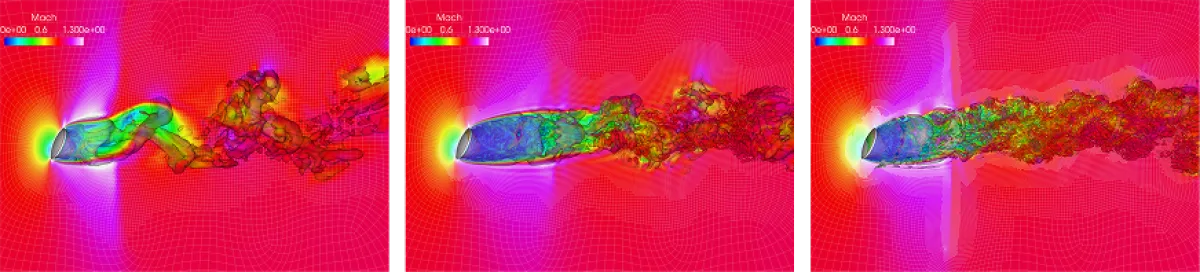
The reentry capsule CFD results clearly demonstrate the effectiveness of adaptive structured meshing. Simulations using adaptive refinement achieve convergence of drag and lift coefficients comparable to uniformly refined meshes, but with substantially fewer total cells. As refinement levels increase, aerodynamic coefficients converge smoothly, indicating that accuracy is governed by targeted resolution rather than global mesh density.
Surface pressure distributions and integrated aerodynamic forces show excellent agreement across successive refinement levels, confirming that key flow physics are captured consistently. Flow visualizations reveal sharply resolved bow shocks and well-defined wake structures, even on meshes that are significantly smaller than equivalent uniform grids. Near the capsule surface, adaptive refinement ensures adequate boundary-layer resolution, supporting reliable heat flux and pressure predictions.
From a computational efficiency perspective, adaptive meshes deliver major reductions in CPU time for equivalent accuracy. Parallel performance remains strong, as refinement is localized and dynamic load balancing maintains reasonable work distribution across processors. These results confirm that adaptive structured meshing is not only accurate, but also scalable and practical for production-level hypersonic CFD.
CONCLUSION
This case study demonstrates how adaptive mesh refinement concepts validated in hypersonic reentry research align naturally with GridPro’s structured multiblock meshing philosophy. By starting with a high-quality, physics-aligned GridPro mesh and applying intelligent, feature-driven refinement, engineers can accurately simulate reentry capsule aerodynamics without the prohibitive cost of uniform mesh refinement.
For space vehicle design and analysis, this approach reduces mesh generation effort, lowers computational expense, and improves confidence in CFD predictions. In hypersonic reentry simulations, adaptive structured meshing is a fundamental requirement for accurately resolving shocks, boundary layers, and wake
structures, and GridPro provides a proven and reliable framework for implementing it within a robust engineering workflow..